
Naturalistic Laboratory Design
Overview
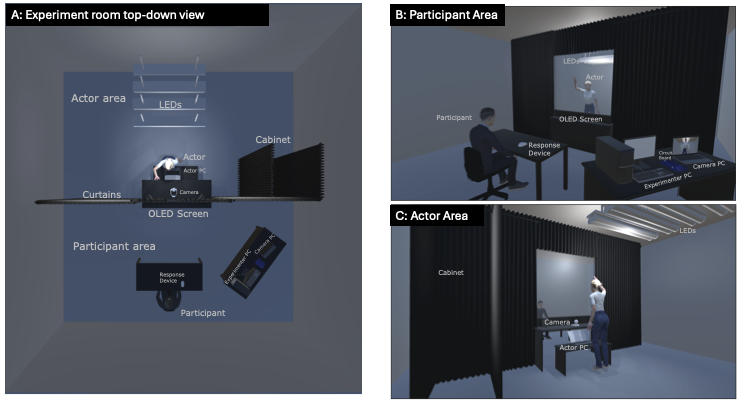
Traditional HRI research often faces a trade-off: screen-based studies offer control but lack realism (low ecological validity), while ‘in-the-wild’ studies offer realism but lack control. In my doctoral research, we targeted the ‘fourth level of naturalism’ by bringing real agents into a controlled laboratory setting. This approach allows for dynamic, contingent social interactions without sacrificing the precise measurement capabilities of a lab environment.
At the core of this setup is the Planar® LookThru™ Transparent OLED Display. This innovative screen alternates between a fully transparent state, allowing participants to view live human or robot actors directly as if through a window, and an opaque state for administering surveys or tasks. This seamless transition enables the presentation of physically present stimuli without disrupting the interaction flow.
To ensure smooth performance, the setup incorporates a Wizard of Oz (WoZ) methodology, creating the illusion of autonomous robot behavior. The physical space is divided by a curtain system and monitored via a hidden camera in the actor area. With this careful design, we could collect time-sensitive behavioral data, such as response times and mouse trajectories, in a fully controlled experiment while providing participants with an immersive experience that goes beyond the limitations of screen-based studies.
The details of the setup and the experiments can be found in the videos of the publications below.
Related Publications
A naturalistic laboratory setup for real-world HRI studies
T. N. Pekçetin, Ş. Evsen, S. Pekçetin, T. D. Karaduman, C. Acarturk, B. A. Urgen
Companion of the 2024 ACM/IEEE International Conference on Human-Robot Interaction, 2024
T. N. Pekçetin, Ş. Evsen, S. Pekçetin, C. Acarturk, B. A. Urgen
Journal of Visualized Experiments, (198), e65436, 2023