
Social Cognition & Mind Perception in HRI
Overview
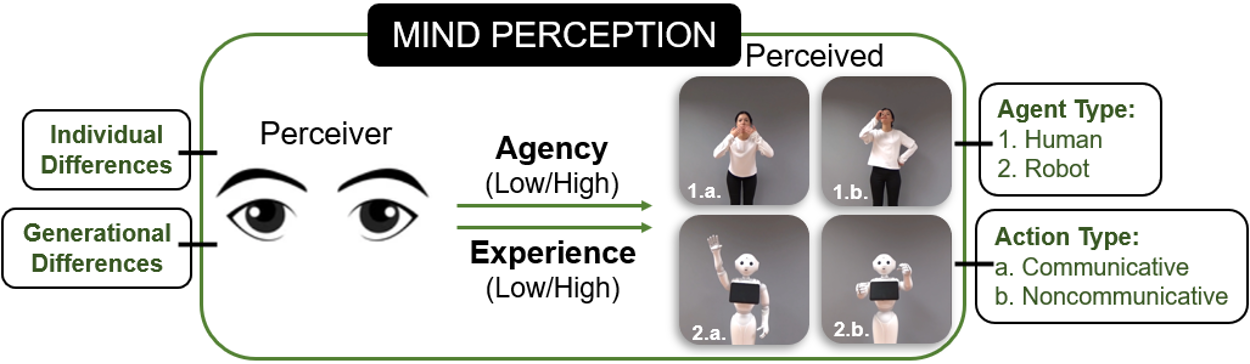
During my doctoral research, I explored the cognitive mechanisms of mind perception, specifically how humans attribute intentions, desires, and feelings to robots. To investigate the causes and consequences of this process, I employed a comprehensive mixed-methods approach combining real-time implicit metrics (e.g., reaction times, mouse trajectories) with explicit surveys and semi-structured interviews.
A key contribution of this work was the development of the Real-World Implicit Association Task (RW-IAT), designed to capture the dynamic nature of mind perception in live interactions. Additionally, to ensure methodological rigor, we conducted normative studies to validate experimental stimuli, addressing critical gaps in the literature.
These investigations involved extensive laboratory experiments, including a large-scale cross-generational study with 160 participants. Our findings showed that while people consistently view humans as mentally superior to robots, this judgment changes significantly depending on the action performed and the observer's age. More importantly, implicit measures (like response times and mouse trajectories) revealed differences in mental capacity attributions that standard surveys missed. These results emphasize why we need multi-layered methods to truly capture the complexity of mind perception dynamics in HRI.
Key Research Questions
- What factors influence people's attributions of mental states and capacities to robots?
- How do agent type (human vs. robot) and action type (communicative vs. noncommunicative) influence mind attribution in real-time interactions?
- How do generational differences and individual traits shape the perception of robot agency and experience?
- To what extent are implicit behavioral metrics (e.g., response times, mouse trajectories) consistent with explicit verbal judgments of mind perception?
Related Publications
T. N. Pekçetin
Middle East Technical University, 2024 • PhD Thesis
Mind perception at play: Exploring agent and action dynamics in real-time human-robot interaction
T. N. Pekçetin, S. Pekçetin, C. Acarturk, B. A. Urgen
Proceedings of the 46th Annual Meeting of the Cognitive Science Society, 2024
Real-world implicit association task for studying mind perception: insights for social robotics
T. N. Pekçetin, Ş. Evsen, S. Pekçetin, C. Acarturk, B. A. Urgen
Companion of the 2024 ACM/IEEE International Conference on Human-Robot Interaction, 2024
Investigating mind perception in HRI through real-time implicit and explicit measurements
T. N. Pekçetin, C. Acarturk, B. A. Urgen
Companion of the 2024 ACM/IEEE International Conference on Human-Robot Interaction, 2024
Studying mind perception in social robotics implicitly: The need for validation and norming
T. N. Pekçetin, B. Barinal, J. Tunç, C. Acarturk, B. A. Urgen
Proceedings of the 2023 ACM/IEEE International Conference on Human-Robot Interaction, 2023
İnsan-Robot Etkileşimine Zihin Algısı Özelinde Bilişsel Bilimler Penceresinden Bakış
B. A. Ürgen, T. N. Pekçetin
Nesne Psikoloji Dergisi, 11(29), 437-448, 2023